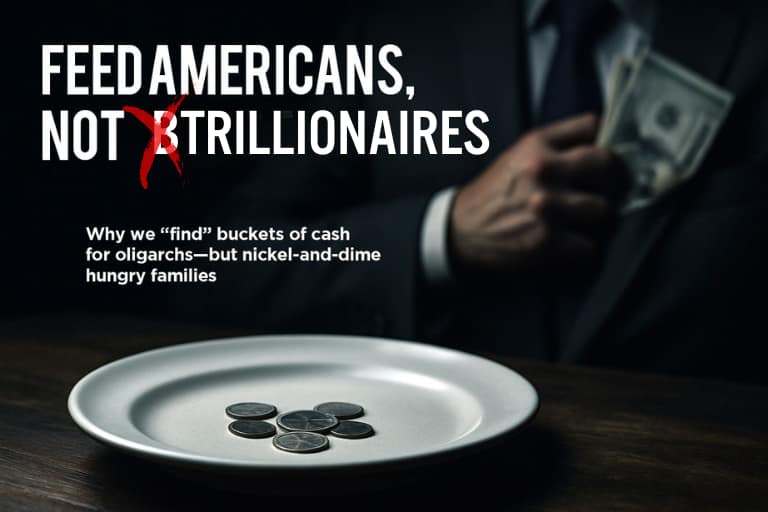
Feed Americans, Not Trillionaires
Why we “find” buckets of cash for oligarchs—but nickel-and-dime hungry families
We keep pretending this is complicated. It isn’t. America is the wealthiest country in the world that makes poor choices—on purpose. We’ll write giant checks to billionaires with a straight face, then look a single mom in the eye and say, “Sorry, the grocery money is too expensive.”
SNAP—the program that keeps about 42 million people eating—costs roughly $8.3 billion per month. Average benefit: about six bucks a day. That’s survival, not luxury.
Meanwhile, the billionaire pipeline flows. Public money, contracts, tax credits, and incentives—hundreds of millions of dollars a month can flow toward the already wealthy, wrapped in words like “innovation,” “efficiency,” and “growth.” Heads, they win, tails, we pay.
We call food for kids “welfare.”
We call cash for oligarchs “investment.”
That’s the con. And surprise, surprise, it has been branded by billionaires.
Sidebar: A Century of “Richest on Earth” — and the New Goalpost
Twelve people have worn the crown since 1900. The successive crown they’re chasing isn’t “richest billionaire.” It’s “first trillionaire.”
From Carnegie to Musk, the crown keeps changing—but the race never stops. The new finish line isn’t a bigger yacht. It’s the first trillionaire.

Why people need help (and who caused it)
People don’t need SNAP because they’re lazy. They need it because work doesn’t pay enough in the bottom half of the economy. Walmart, McDonald’s, and other large employers suppress wages and maintain unstable schedules. Taxpayers then backfill the gap so their workers can eat—and those same employers capture the sales at the register. It’s a neat little circle of greed: low pay → public aid → corporate revenue.
In 2023, the Supplemental Poverty Measure (the one that actually counts noncash help and modern expenses) rose to 12.9%—42.8 million people. That’s after the temporary pandemic supports ended. Poverty up. Rents up. Groceries up. Tell me again how people “need to budget better.”
The fraud myth (spoiler: it’s tiny)
You’ve been fed media stories about SNAP “abuse.” Here are the receipts:
If fiscal integrity matters, don’t weaponize a 1–2% error rate to cut food for kids while funneling ten-figure subsidies to private space ventures.
Public cash for private empires
Let’s say the quiet part loud. Public money built private fortunes, especially at the top. Investigations reveal that Musk’s empire was shaped by decades of loans, contracts, grants, tax credits, and regulatory incentives—from Tesla’s DOE loan and EV credits to NASA/DoD contracts, as well as local incentive packages for factories and launch sites. In 2024 alone, about $6.3 billion in support; since inception: $38 billion.
Public-private partnerships aren’t the problem; asymmetric risk is. Failures are socialized as public costs, while successes are privatized as equity gains that translate into political power. That’s how an aspiring trillionaire emerges while the school lunch line grows longer.
Put plainly: low-income families end up subsidizing the ultra-rich.
The billionaire party while America skips dinner
While SNAP is squeezed and food banks see lines, the oligarch class is out here cosplaying The Great Gatsby—Venetian wedding spectacles, ballroom galas, fleets of jets and yachts—exactly when hunger programs twist in the wind.
And that’s just the invitations. The running tab for club fly-ins and golf weekends at private resorts—millions per weekend in public expense, plus government payments flowing into the same properties for security details and staff lodging. We police a $6/day grocery card like it’s grand larceny, but wave through club weeks that burn through millions before the dessert course.
“But judges…” — yeah, let’s talk about the courts
You asked what is wrong with the courts. Here’s a short, sober version:
Put bluntly: a string of decisions supercharges billionaire influence, weakens unions, and hobbles the regulators who protect the rest of us. So yes, it can feel like robed referees are toasting with $100 wine while workers get means-tested to death.
What do we do? We change the rules: pass real campaign-finance laws that survive scrutiny, push for public financing, demand a binding judicial ethics code, expand lower courts to clear backlogs, and—where states elect or retain judges—organize and vote accordingly. We don’t “unelect” federal judges; we out-organize the billionaires who picked them.
It’s not envy. It’s priorities.
SNAP isn’t “waste.” It’s breakfast that lets a kid learn, a senior choosing food and medicine, a worker making rent and groceries when the schedule roulette wheel comes up short.
$8.3B/month buys dignity in a nation that can easily afford it.

If you still think we can’t fund a basic grocery lifeline, ask why we always “find” endless money for launch pads, stadium tax breaks, lavish security at private clubs, and subsidies that fatten the already-fattened—while means-testing bananas.
The Fix: Feed America, Then Innovate
The line in the sand
“We can’t afford $8.3B a month for food”? Stop it.
Here’s what $8.3 billion/month buys America:
Average SNAP benefits were about $187–$188 per person per month in 2024—around $6 a day. That’s not luxury; it’s survival.
If we can find approximately $500 million a month for a man who’s already the richest on Earth, we can find $8.3 billion a month to ensure that kids and seniors have access to food. One of those investments builds a decent country. The other builds a bigger yacht.
So I’ll say it plain:
Feed Americans, Not Billionaires.
People first. Groceries first. Dignity first. Trillionaires can wait.
Feed Americans, Not Trillionaires.